

Most people wait to feel ready. They wait for motivation, for inspiration, for the “right moment.” One day you feel unstoppable; the next you can’t even open your laptop.
The Stoics didn’t wait. They understood something modern culture keeps forgetting: feelings are unstable, but discipline endures. If your progress depends on motivation, your progress will always be fragile.
Why motivation fails you
Motivation comes and goes. It disappears exactly when life gets uncomfortable, boring or difficult, which is when you need it most. When you rely on it:
- You act only when it feels easy.
- You quit when resistance appears.
- You confuse a feeling with a commitment.
The Stoics didn’t build their lives around emotional energy. They built them around principles and habits. Discipline is simply the steady, deliberate commitment to do what must be done, whatever you happen to feel that day.
Marcus Aurelius didn’t feel like getting up either
The most powerful man in the Roman world wrote a note to himself about getting out of bed. That note survives as the opening of Book 5 of his Meditations:
“In the morning when thou findest thyself unwilling to rise, consider with thyself presently, it is to go about a man’s work that I am stirred up.”
Marcus Aurelius, Meditations 5.1 (Casaubon translation)
Notice what he doesn’t say. He doesn’t tell himself to wait until he feels energized. He admits the unwillingness, then answers it with a reason: there is work to do, and doing it is what a human being is for. The feeling is acknowledged and then overruled.
That’s the whole Stoic approach in one sentence. Right action comes before right feeling, not the other way around. You don’t wait to feel courageous to act with courage, or calm to act with restraint. Act first; the feeling tends to follow.
Discipline is freedom, not a cage
Modern thinking often treats discipline as restrictive. The Stoics saw it the other way round:
“No man is free who is not master of himself.”
Epictetus, Golden Sayings XV (Crossley translation)
When you are disciplined, you are not ruled by impulses, controlled by moods, or dependent on perfect conditions. You’re free from procrastination, excuses and regret. Self-command is the only kind of freedom nobody can take from you.
Nothing great happens suddenly
Motivation loves big dramatic starts. Discipline is quieter, and Epictetus explained why it works better:
“Nothing great, said Epictetus, is produced suddenly, since not even the grape or the fig is. If you say to me now that you want a fig, I will answer to you that it requires time: let it flower first, then put forth fruit, and then ripen.”
Epictetus, Discourses 1.15 (George Long translation)
Character is built the same way: quietly, on ordinary days, long before it is tested. That’s why the Stoics trained when nothing dramatic was happening. Small daily discipline looks insignificant (waking up when you said you would, doing the hard task first, speaking less and thinking more) until life suddenly demands strength.
Five habits that replace motivation
1. Focus on what you can control
Moods, energy and circumstances are unreliable. Your next action is not. Begin each day with one small action that sets the tone, no matter how you feel, and remind yourself: my actions, not my emotions, define me.
2. Commit to daily action
Set a few non-negotiable daily actions tied to your goals. Track them with a simple checklist. Small wins compound; occasional heroic bursts don’t.
3. Treat discomfort as training
Resistance is a signal that growth is near, not a sign to stop. Now and then choose the harder path on purpose (the cold shower, the walk instead of the ride, the task you’ve been avoiding) to strengthen the muscle you’ll need on the days you don’t get to choose.
4. Replace inspiration with systems
Motivation may push you to start; systems keep you going. Do your most important work at the same time each day. Anchor the day with rituals: a morning intention and an evening review. Automate or delegate what doesn’t need you.
5. Replace moods with standards
Instead of asking “Do I feel like it today?”, ask “Is this who I decided to be?” Standards don’t negotiate with mood, weather or comfort. Marcus Aurelius kept his standard short:
“If it be not fitting, do it not. If it be not true, speak it not.”
Marcus Aurelius, Meditations 12.17 (Casaubon translation)
Stop postponing the person you want to be
Epictetus asked his students a blunt question that still lands two thousand years later:
“How long will you then still defer thinking yourself worthy of the best things?”
Epictetus, Enchiridion 51 (George Long translation)
Waiting to feel ready is a way of deferring. The strongest people aren’t the most motivated; they’re the most consistent. Stop waiting for permission from your emotions and start acting from principle. Progress becomes steady, confidence becomes quiet but real, and life gets simpler and stronger.
Don’t wait to feel ready. Do what must be done, and let readiness follow.
Related reading: Stoicism and the power of self-discipline and the Stoic morning routine.
Frequently asked questions
Why is discipline better than motivation?
Motivation is a feeling, so it rises and falls with your mood and circumstances. Discipline is a practice you control. It keeps you acting on the days motivation disappears, which are usually the days that matter most.
What did the Stoics say about discipline?
They treated self-mastery as freedom. Epictetus: “No man is free who is not master of himself.” Marcus Aurelius reminded himself each morning that rising to do his work was what he was made for, whether he felt like it or not.
How do I stay consistent when I don’t feel like it?
Shrink the task to a first action you can do in two minutes, tie it to a fixed time, and judge the day by whether you kept your standard, not by how you felt. Feelings often follow action.
Where can I read Marcus Aurelius and Epictetus for free?
Public-domain translations are free on Project Gutenberg (Meditations) and Project Gutenberg (Epictetus, Long translation).
Epic Stoic publishes one deep-dive on Stoic philosophy every week: the original texts, what they meant, and how to use them. Watch the short version on our YouTube channel.
Recommended reading
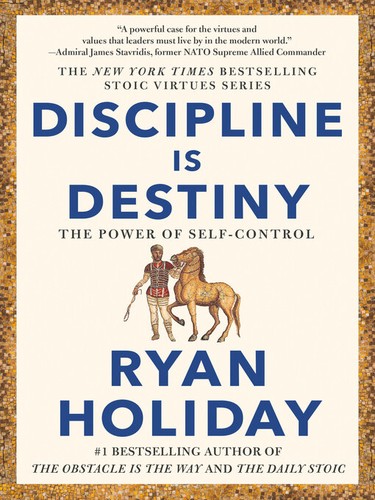
Discipline Is Destiny
Ryan Holiday
The second Stoic virtue, self-control, told through the lives of people who mastered themselves.

Meditations
Marcus Aurelius, translated by Gregory Hays
The private notebook of a Roman emperor. Short entries you can open anywhere; the most readable modern translation.
As an Amazon Associate we earn from qualifying purchases. More picks on our Books page.
