

It is the evening before a family gathering. The oven timer is going off, your phone has three unread messages about who is bringing what, and somewhere in the back of your mind you are already rehearsing the conversation with the relative who always finds something to criticise. The holidays are supposed to be restful. Somehow they rarely are.
None of this is new. Two thousand years ago the Romans had their own winter festival, the Saturnalia, and it came with the same mix of feasting, gift-giving, noise and pressure. The Stoics lived through it like everyone else. What they wrote about it is surprisingly useful for a modern December: not a rule against celebrating, but a way to stay calm, grateful and clear-headed while everyone around you is running.
Seneca in December
Seneca opens one of his letters to his friend Lucilius with a scene that could describe any city in the last week of the year:
“It is the month of December, and yet the city is at this very moment in a sweat.”
Seneca, Moral Letters to Lucilius 18.1 (Richard Mott Gummere translation)
He goes on to describe the general merrymaking and the “mighty preparations”, and then asks a question his friend probably didn’t expect: should we join in or stay apart? His answer is balanced. Staying sober while the crowd is drunk takes courage, he admits, but it takes more self-control to stay in the crowd and do what it does in a different way, neither making yourself conspicuous nor disappearing into it. One may keep holiday, he says, without extravagance. Enjoy the feast; don’t become the feast.
That is the spirit of every practice below. The Stoic holiday is not a grim one. It is a holiday where you stay in charge of yourself.
Five Stoic practices for the season
1. Choose presence over perfection
Most holiday stress comes from a picture in our heads: the perfect meal, the perfect gifts, the family that gets along for one full day. Then reality arrives, and we spend the day comparing it to the picture.
The Stoics would say the picture is the problem. The weather, the traffic, the burnt dish and the mood of your brother-in-law are not up to you. How you meet them is. When you let go of the script, you are free to notice what is actually happening in the room: a child laughing, an old story being told again, a quiet moment in the kitchen.
2. Practice gratitude by imagining loss
Gratitude is easy to talk about and hard to feel on demand. The Stoics had a sharper tool. Epictetus asks his students to change the way they speak about the things and people they love:
“Never say about anything, I have lost it, but say I have restored it.”
Epictetus, Enchiridion 11 (George Long translation)
Everything we have, he says, is on loan. That sounds bleak at first, but its effect is the opposite. When you look around a crowded table and remember that none of these people is guaranteed to be there next year, the small irritations shrink and the ordinary moments start to glow. You stop taking the evening for granted because you know it is a gift and not a possession.
3. Restrain excess, without rejecting joy
Temperance, knowing when enough is enough, is one of the four Stoic virtues. Holidays test it hard: one more plate, one more drink, one more purchase. The Stoic answer is not to refuse pleasure but to stay the one who decides. You can enjoy a good meal fully and still stop when you have had enough. You can give generously without spending money you don’t have to impress anyone.
A simple test before each “one more”: will I be glad tomorrow that I did this? If the honest answer is yes, enjoy it. If not, let it pass.
4. Rehearse simplicity, so you fear it less
In the same December letter, Seneca gives Lucilius an unusual piece of homework:
“Set aside a certain number of days, during which you shall be content with the scantiest and cheapest fare, with coarse and rough dress, saying to yourself the while: ‘Is this the condition that I feared?'”
Seneca, Moral Letters to Lucilius 18.5 (Richard Mott Gummere translation)
His point is that a season of plenty is the best time to train for a season of less. If you have spent a day on plain food and simple comforts and found that you were fine, the fear of losing money, status or comfort loosens its grip. In a modern holiday this could be one quiet day between the big events: simple meals, no shopping, a walk instead of a screen.
5. Remember that time is short
The Stoics used reminders of mortality, memento mori, to sharpen their attention rather than to darken their mood. The holidays are a natural moment for this. The grandparent at the end of the table, the friend you only see once a year, the children who will soon be too old to care about presents: each of these moments is limited. Knowing that is what makes them precious.
A Stoic holiday exercise: the three-part evening review
The quiet evenings at the end of the year are well suited to the Stoic habit of reviewing the day. Try this on any evening during the season. It takes about ten minutes.
- Find a quiet spot. After the guests leave or the house goes to sleep, sit somewhere calm with a notebook. No phone.
- Name one thing you received today. Not a gift necessarily: a conversation, a meal, a moment of help. Write it down as something “lent” to you, in the spirit of Epictetus.
- Name one moment you lost your composure. A sharp reply, a sulk, an argument about politics. Describe it plainly, without excuses and without beating yourself up.
- Separate what was up to you from what wasn’t. The relative’s comment was not yours to control. Your reply was. Write one sentence about how you would like to respond next time.
- Look ahead to tomorrow. Who will you see? What is likely to test you? Decide now, calmly, how you want to show up.
- Close with one line of thanks. For a person, a place, or simply for having another day.
Done for a week, this turns the holidays from a blur into a series of days you actually lived.
A common mistake: treating Stoicism as a reason to opt out
Some people come to Stoicism and decide that the right move is to skip the festivities, sit in the corner with a serious face and look down on all the fuss. That is not what the Stoics taught.
Seneca says it directly in Letter 18.4: the greater self-control lies in joining in, in a different way, rather than making yourself conspicuous by withdrawing. Marcus Aurelius spent his life as an emperor surrounded by ceremonies he did not choose. Stoicism is not about avoiding people; it is about keeping your judgment intact while you are with them.
A second mistake is confusing calm with not caring. A Stoic at a family dinner is not cold or detached. They are warm, attentive and patient, precisely because they are not being pushed around by every small irritation. Calm is what makes real kindness possible.
A calm season
A Stoic holiday is not loud or rushed, and it is not joyless either. It is intentional. You enjoy what is in front of you, you keep your temper when things go wrong, and you remember that the people at the table are on loan.
You don’t escape the season by practising this way. You experience it more fully.
Happy holidays,
EpicStoic Team
Recommended reading
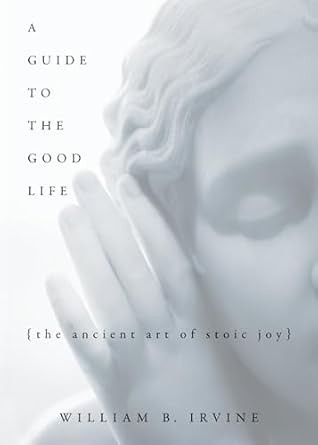
A Guide to the Good Life
William B. Irvine
The book that started the modern Stoic revival. Clear, practical, and honest about what works in daily life.

Meditations
Marcus Aurelius, translated by Gregory Hays
The private notebook of a Roman emperor. Short entries you can open anywhere; the most readable modern translation.
As an Amazon Associate we earn from qualifying purchases. More picks on our Books page.
