
Your phone buzzes at a red light. It’s a photo from your sister: your dad, asleep in his armchair with the grandkid on his chest, both of them snoring. You smile, type “lol,” and drive on. Somewhere in the back of your mind a quieter thought flickers: he looks older than he did last year. You push it away. Too dark for a Tuesday.
That small flicker, and the reflex to push it away, is exactly where the Stoic practice of memento mori lives.
The memento mori meaning is simple: “remember that you will die.” Most articles stop at the skull on the desk and a vague message about seizing the day. But the Stoics had a sharper point, and they had to defend it against the very objection you probably have right now: isn’t that morbid? Epictetus heard that complaint from his students almost two thousand years ago. His answer is the most useful thing ever written on the subject, and almost nobody quotes it.
Memento mori meaning: where the phrase actually comes from
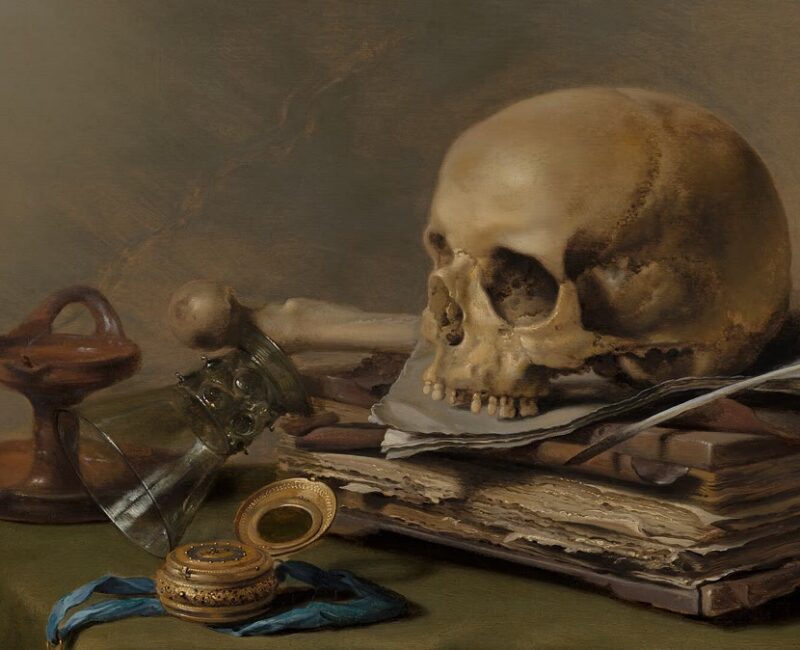
First, an honest bit of source-checking. The Latin phrase memento mori does not appear in Seneca, Epictetus, or Marcus Aurelius. It became a fixed motto later, in medieval Christian art and in the “vanitas” paintings of the 1600s, like the skull, books, and overturned glass in the still life at the top of this page.
The idea, though, is thoroughly Stoic. And there is a Roman custom behind it that Epictetus mentions directly. When a general rode through Rome in a triumph, someone stood behind him whose job was to keep him grounded. Epictetus tells us to treat our own joys the same way: when you love someone, he says, check your feelings,
“and curb it as those who stand behind men in their triumphs and remind them that they are mortal.”
Epictetus, Discourses 3.24 (trans. George Long)
Notice the setting. Not a funeral. A victory parade. The reminder of death was not for your worst day. It was for your best one.
The objection Epictetus saw coming
Here is the passage that makes Stoic memento mori different from every motivational poster. In the same discourse, Epictetus gives what sounds like a shocking instruction:
“What harm is it while you are kissing your child to say with a lisping voice: To-morrow you will die; and to a friend also: To-morrow you will go away or I shall, and never shall we see one another again?”
Epictetus, Discourses 3.24
Read that again with modern eyes and it sounds awful. Whisper “you will die” into your baby’s hair? Even his Roman students flinched. Epictetus answers their protest himself, and he doesn’t pretend it isn’t uncomfortable:
“But these are words of bad omen—and some incantations also are of bad omen; but because they are useful, I don’t care for this; only let them be useful.”
Epictetus, Discourses 3.24
Then he turns the objection around. What is actually “of bad omen,” he asks? Words that point to something evil: cowardice, meanness, shamelessness. Those are the dark words. A word that points to something natural is not. And then comes the image that unlocks the whole practice:
“say that even for the ears of corn to be reaped is of bad omen, for it signifies the destruction of the ears, but not of the world.”
Epictetus, Discourses 3.24
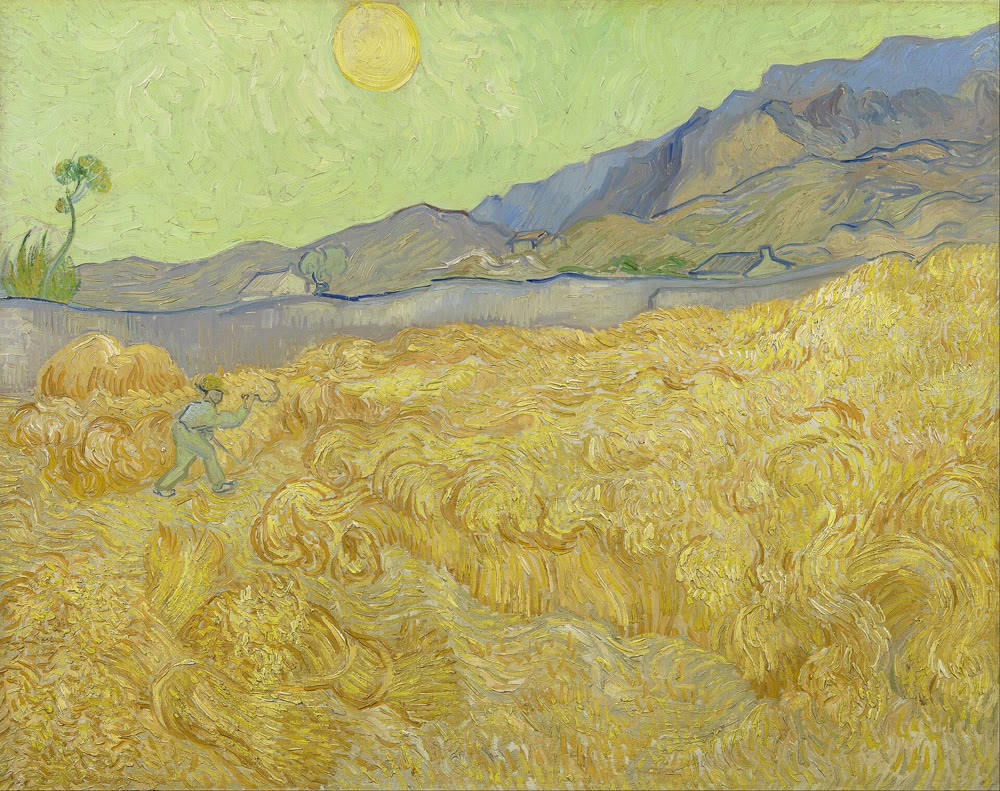
Nobody calls a harvest morbid. Nobody grieves when leaves fall in October or when grapes become raisins. Epictetus lists exactly those examples, and calls them “changes from a former state into other states; not a destruction, but a certain fixed economy and administration.” Death, in his view, belongs on that list. It is the biggest item on it, but it is the same kind of thing.
That is the Stoic key to practicing memento mori without being morbid. Morbidity is staring at death as a horror. The Stoic move is to see it as part of nature’s normal schedule, like a season, and then let that clear view change how you spend the day you’re in.
The fig in winter
Epictetus has one more image in this discourse, and it explains why the practice isn’t cold. What you love, he says, “has been given to you for the present,” the way a fig or a bunch of grapes is given at the right season of the year. Then:
“So if you wish for your son or friend when it is not allowed to you, you must know that you are wishing for a fig in winter.”
Epictetus, Discourses 3.24
Think about how you eat a fig in season. You don’t eat it grimly because it won’t last. You eat it with more attention, precisely because you know it won’t. The seasonal view doesn’t drain the sweetness; it is the reason you notice the sweetness at all.
The shorter version of the same idea is in the Enchiridion, the handbook of Epictetus’s teaching:
“If you are kissing your child or wife, say that it is a human being whom you are kissing, for when the wife or child dies you will not be disturbed.”
Epictetus, Enchiridion 3
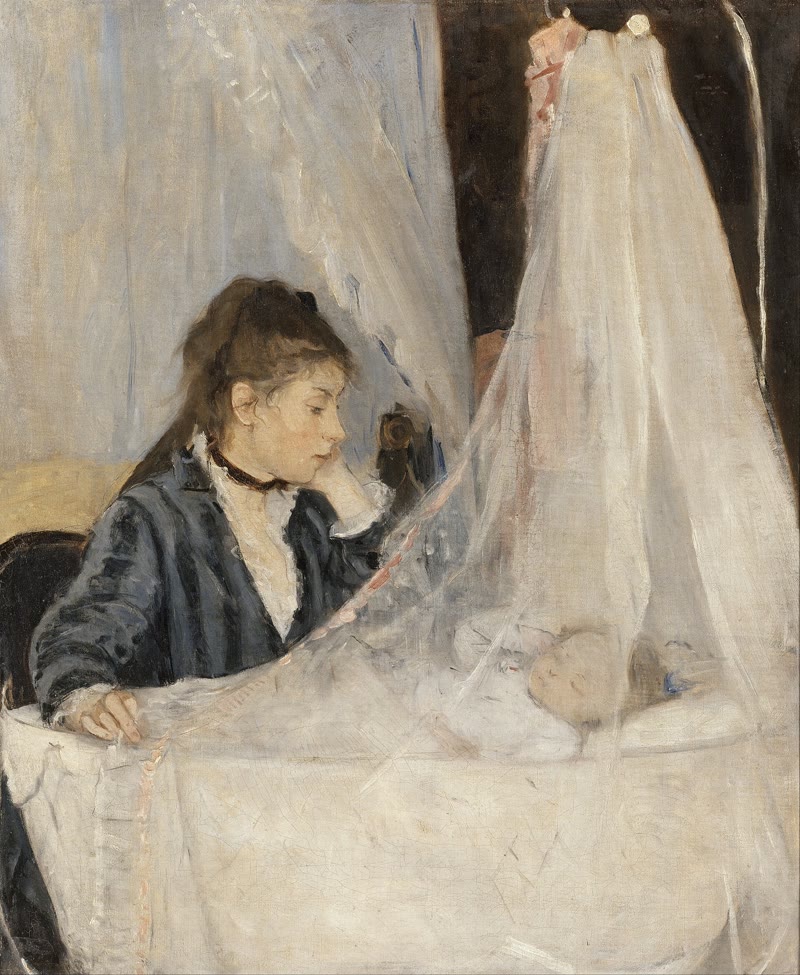
The phrase “you will not be disturbed” is where people stumble, and we’ll come back to it. For now, notice what comes first: you are still kissing your child. The practice happens inside the act of love, not instead of it.
Marcus and Seneca: what the reminder is for
Marcus Aurelius, writing to himself as emperor, uses the reminder as a steering wheel rather than a weight:
“Since it is possible that thou mayest depart from life this very moment, regulate every act and thought accordingly.”
Marcus Aurelius, Meditations 2.11 (trans. George Long)
And more bluntly, two books later:
“Do not act as if thou wert going to live ten thousand years. Death hangs over thee. While thou livest, while it is in thy power, be good.”
Marcus Aurelius, Meditations 4.17
Look at where each sentence lands. Not “be afraid.” Not “hurry and cram in experiences.” Be good. For Marcus, remembering death is a filter for priorities: the petty grudge, the email you’re drafting in anger, the call you keep postponing. Each of them looks different when you stop assuming you have ten thousand years.
Seneca adds the part people forget: the emotional payoff. In Letter 12, written when he was already old, he insists that “Death, however, should be looked in the face by young and old alike” (12.6). Then he describes what that honest look gives you:
“That man is happiest, and is secure in his own possession of himself, who can await the morrow without apprehension. When a man has said: “I have lived!”, every morning he arises he receives a bonus.”
Seneca, Moral Letters to Lucilius, Letter 12.9 (trans. Richard Gummere)
A bonus. That’s the opposite of morbid. If you have accepted that today could be the end, then tomorrow stops being an entitlement and starts being a gift. Ordinary mornings get a little brighter.
How to practice memento mori today
Here is the Stoic material turned into a practice you can do in the next 24 hours. It takes a few minutes, and none of it requires a skull on your desk.
- Pick one “triumph” moment. Choose a good moment you expect today: a win at work, dinner with your partner, your kid’s bedtime. That is where the reminder goes, the way the Romans placed it in the victory parade.
- Add the quiet sentence. In that moment, say to yourself (silently is fine): “This is a human being, and this is a season.” You don’t need Epictetus’s exact words. You need the fact underneath them.
- Notice one detail on purpose. Let the reminder sharpen your attention, like eating the fig in season. The sound of their laugh. The light in the kitchen. One concrete detail you’d otherwise miss.
- Run Marcus’s filter once. Before one decision today, ask: “Would I still do this if I didn’t have ten thousand years?” If the answer is no, drop it or change it.
- Close one open loop. Send the message, make the call, say the thank-you you’ve been saving for later. Then let it go.
- Tomorrow morning, count the bonus. When you wake up, name it in one line: “Another day I didn’t have to get.” That’s Seneca’s bonus, received on purpose.
This is different from a nightly review (we covered that in the one Stoic habit that changes your evenings) and from a planned start to the day (see the Stoic morning routine). Memento mori lives in the middle of the day, inside the good moments. It also pairs naturally with the Stoic art of letting go.
Here’s the 30-second version, if there’s someone you’ve been meaning to call:
What memento mori does not mean
It doesn’t mean dwelling on death. Seneca shows the difference with a cautionary tale in the same Letter 12. A Roman governor named Pacuvius held a mock funeral for himself every evening, with wine and feasting, while servants sang “He has lived his life!” Seneca’s verdict: do it “from a good motive” instead of a debased one. The point isn’t theater or gloom. It’s a quiet acceptance that sets you free to enjoy the next day.
It doesn’t mean “live like there’s no tomorrow.” The popular YOLO reading says: life is short, so grab every pleasure. Marcus says the opposite. Life is short, so be good. The reminder is meant to make you more careful about what matters, not more reckless.
It doesn’t mean loving people less. When Epictetus says that if your child dies “you will not be disturbed,” he is describing a philosopher’s ideal of not being overthrown by grief. He is not telling you to keep people at arm’s length. His instruction is literally given while you are kissing them. Many modern Stoics read it as: love fully, and know what you’re holding. You’ll still grieve. You’ll grieve without the added shock of having pretended it could never happen.
It isn’t a substitute for help. If thoughts about death feel intrusive, frightening, or hard to switch off, that’s not a Stoic exercise going well. Talk to someone you trust or a professional.
Frequently asked questions
What is the meaning of memento mori?
It’s Latin for “remember that you will die.” In Stoic practice it means keeping your mortality in view so that you use your time well, act on your values now, and appreciate the people and moments you have, rather than assuming there will always be later.
Did the Stoics say “memento mori”?
Not in those words. The Latin motto became popular in later centuries, especially in medieval and 17th-century art. But the practice itself is all over the Stoic texts: Epictetus in Discourses 3.24 and Enchiridion 3, Marcus Aurelius in Meditations 2.11 and 4.17, and Seneca in his letters, including Letter 12.
Is memento mori morbid or depressing?
Epictetus answered exactly this complaint. He argued that a word is only “of bad omen” if it points to something evil, like cowardice. Death is a natural change, like ears of corn being reaped or leaves falling. Practiced that way, the reminder tends to make ordinary days feel more valuable, not darker.
How do you practice memento mori every day?
Place a short reminder inside a good moment (“this is a human being, this is a season”), use it to notice one detail, run one decision through Marcus’s question about ten thousand years, close one open loop, and greet the next morning as Seneca’s bonus. A few minutes a day is enough.
What is a memento mori object?
Any physical reminder of mortality: a skull in a painting, an hourglass, a coin engraved with the phrase. The objects are a later tradition. For the Stoics, the reminder was mainly a thought you carried, not a thing you owned.
If you want to read Epictetus’s full discourse, including the ears of corn and the fig in winter, George Long’s translation is free on Project Gutenberg. Look for the chapter titled “That we ought not to be moved by a desire of those things which are not in our power.”
Epic Stoic publishes one deep-dive on Stoic philosophy every week: the original texts, what they meant, and how to use them. Watch the short version on our YouTube channel.
Recommended reading
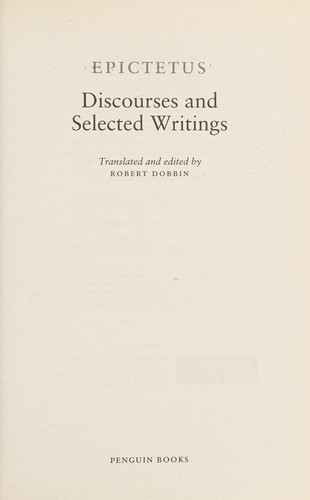
Discourses and Selected Writings
Epictetus, translated by Robert Dobbin
The teaching of the former slave who became Stoicism’s sharpest teacher, including the famous Enchiridion (Handbook).
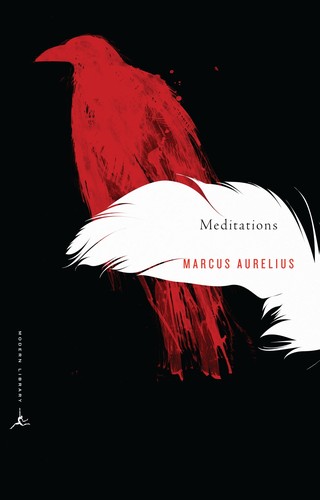
Meditations
Marcus Aurelius, translated by Gregory Hays
The private notebook of a Roman emperor. Short entries you can open anywhere; the most readable modern translation.
As an Amazon Associate we earn from qualifying purchases. More picks on our Books page.
